The Story Behind Focura
I Had a Good Job
I was a data scientist at a Swiss bank on Wall Street: good money, working from home, and often only two or three hours of focused work a day. I often played basketball at 11am, had enough flexibility to travel around the US, and visited more than half of the national parks. It should have felt like freedom.
But I felt trapped.
I was under-challenged, tired of office politics, and restless with a lingering desire to create something new. I felt guilty for staying at the comfortable life and not following my instinct to quit the job and adventure.
To be fair, quitting was hard. Especially for an international student building a life in the US, a stable job meant income, legal status, immigration progress, and my parents' bragging rights. To quit, I had to face those fears.
I found clarity through a simple mental exercise: imagining myself looking back from the end of my life. One fear became obviously stronger than the others: the fear of never allowed myself to grow into my potential.
I told my manager I wanted to resign over lunch at an Indian restaurant in Manhattan. She called my decision 'impulsive', but was kind enough to suggest that I stay two more months for the annual bonus.
But I didn't.
In January 2022, at 30 years old, I quit.
Starting Over
I started exploring a few directions: web3, AI, quant, and eventually education. I created a tool called Learniverse, which helps users curate personalized courses based on their learning goals and background.
Over time, Learniverse grew into a comprehensive education platform with over 8,000 users. As a one-person team, it taxed me heavily, both mentally and physically. As a result, I kept burning out. I was spending over 30% of my time recovering from burnout.
I knew I needed to level up the way I worked, or I stood no chance.
The Inspiration and MVP
While recovering from burnout at the gym, I had a realization: My body rarely burned out at the gym. Could my work learn from it?
I had been training consistently. My body was getting stronger over time, and I rarely experienced regression or injury.
I started writing down why after that gym session. This was the core of it:
What I noticed at the gym:
- Break regularly between each set
- Clearly define what to do
- Estimate workload based on current physical condition
- Know my limits and avoid being too ambitious
- Gradually increase the load
- Trust long-term progress, even without immediate feedback
I tried to apply them to my work:
| Gym inspiration | Applying to work | |
|---|---|---|
| Break between sets | → | Break after each task |
| Clearly define what to do | → | Define 30-min tasks |
| Estimate by condition | → | Estimate hours upfront |
| Know your limits | → | Monitor your limits |
| Build load progressively | → | Avoid context switching |
| Trust long-term progress | → | Accept delayed feedback |
With the inspiration, I built a Shortcuts App called "Work Timer and Journal", to test if the idea borrowed from gym session can help my work.
It was simple — a focus session timer that prompted me to define what I'd work on, ran a countdown, asked for a reflection afterward, and logged everything to Notes app.
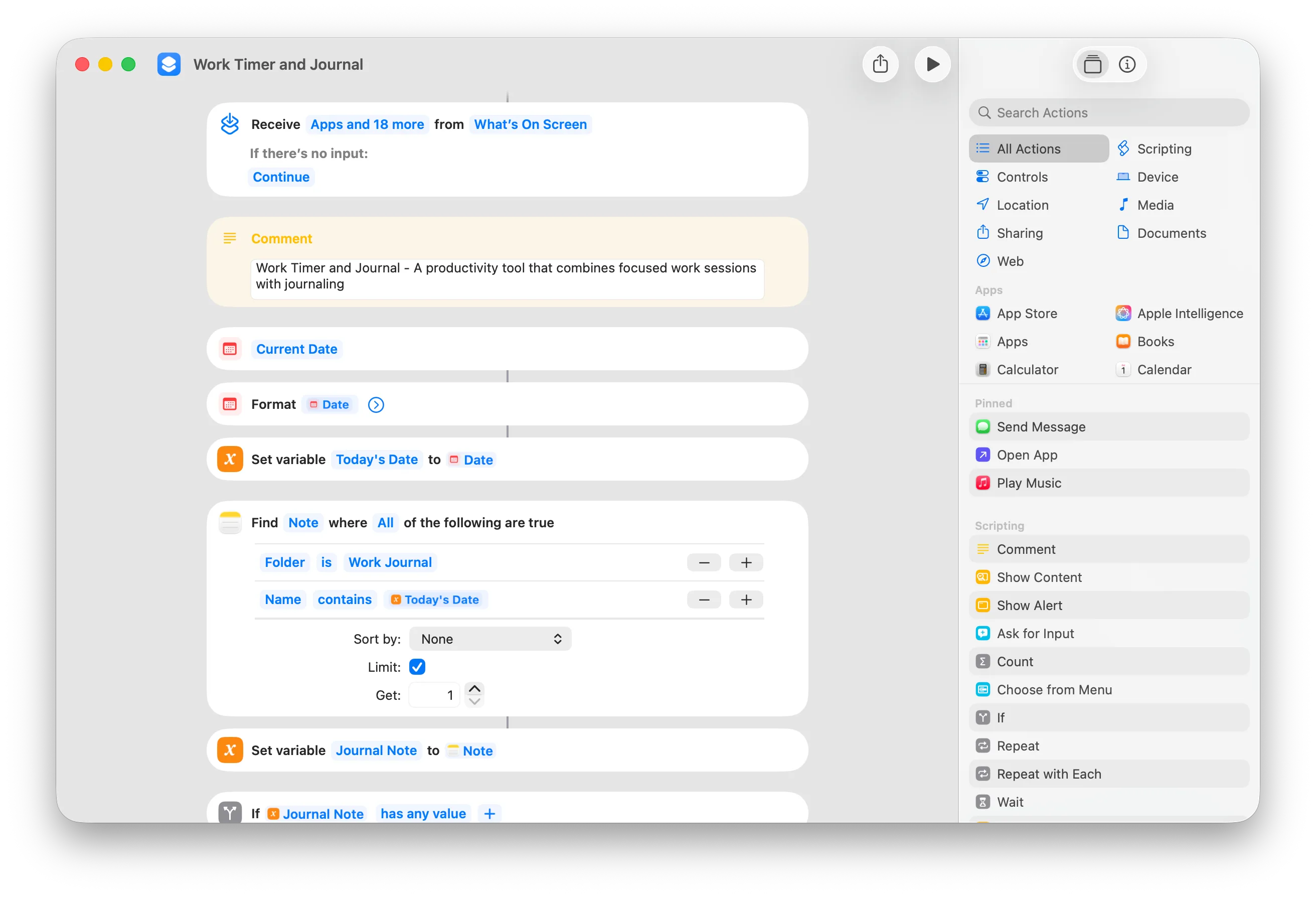
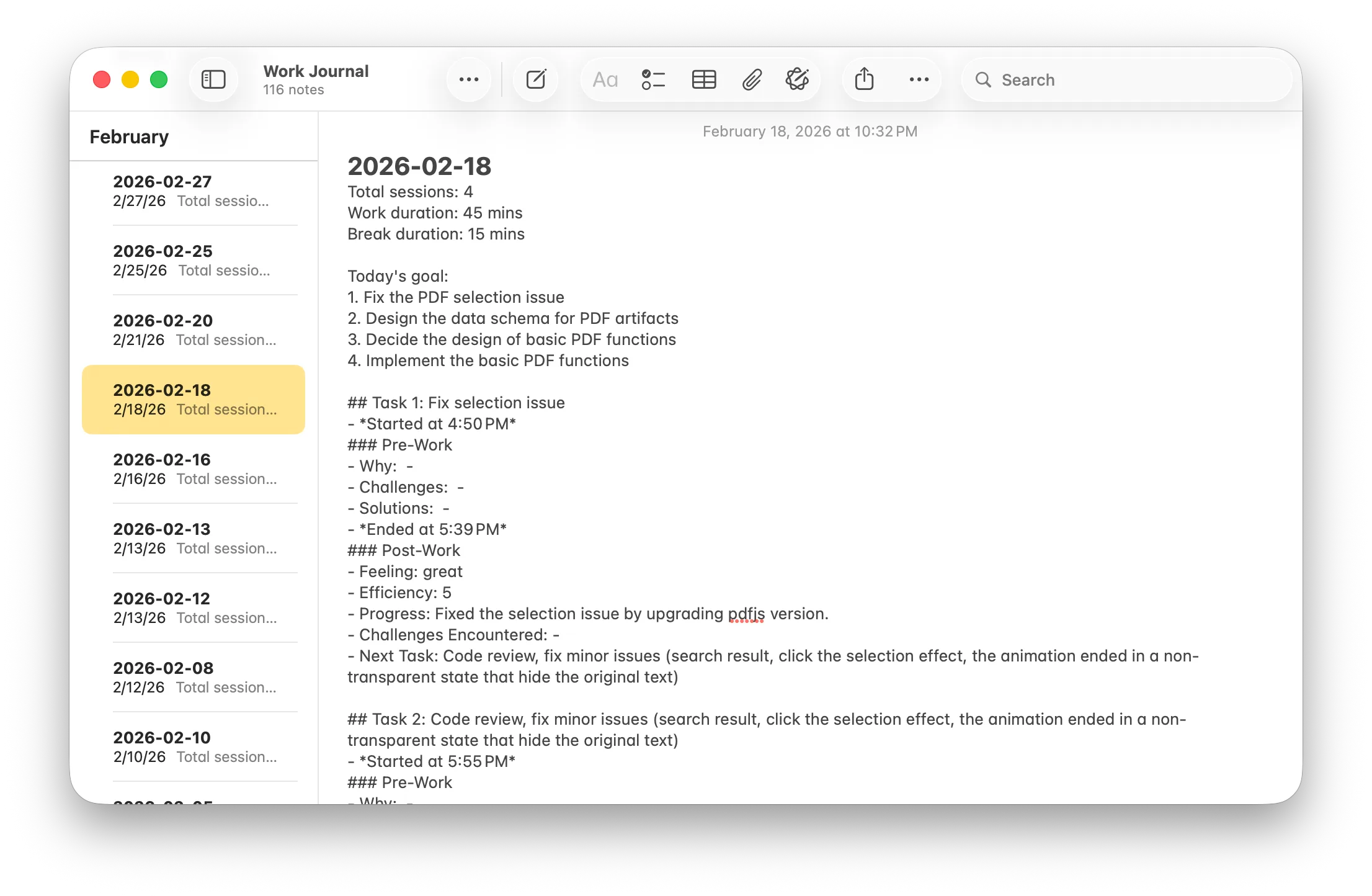
How It Worked
It was far from a polished product, but already helpful. I used it on 116 days over the last year.
For context, I usually did not remember it when I was working well. I remembered it when I felt lost, overwhelmed, depressed, unsure where to start, or caught by procrastination and perfectionism. Those were the days I turned to the tool for help.
I had 116 of those days last year. Without the tool, many of them could have become days where I did nothing.
Through 2025, while I was fighting depression, traveling, and slowly recovering, I kept using and improving it. The tool stayed small, but the pattern became clearer every month.
What worked. It helped me start. The prompt forced me to seek clarity on what to do and focus on one specific task. For a brain that regularly understands a task is important but can't activate the action, that small structure made a real difference.
What didn't. Because activation became easier, I became even more fatigued. I would constantly forget to stop while in hyperfocus mode and work for another hour without realizing it. In hindsight, not overworking myself would have been the smart decision. But I tend to be greedy and shortsighted. The fear of losing context also kept me going.
The final push. I shared the idea with friends, and many of them were interested in trying the Shortcuts app. But Apple Shortcuts can't be shared well.
On March 27, 2026, I felt it was time to build a full-fledged Mac app.
And here we are.